
Stay up to date with the latest developments
Leave your email address and receive the latest developments in software, AI and Mendix.
Leave your email address and receive the latest developments in software, AI and Mendix.
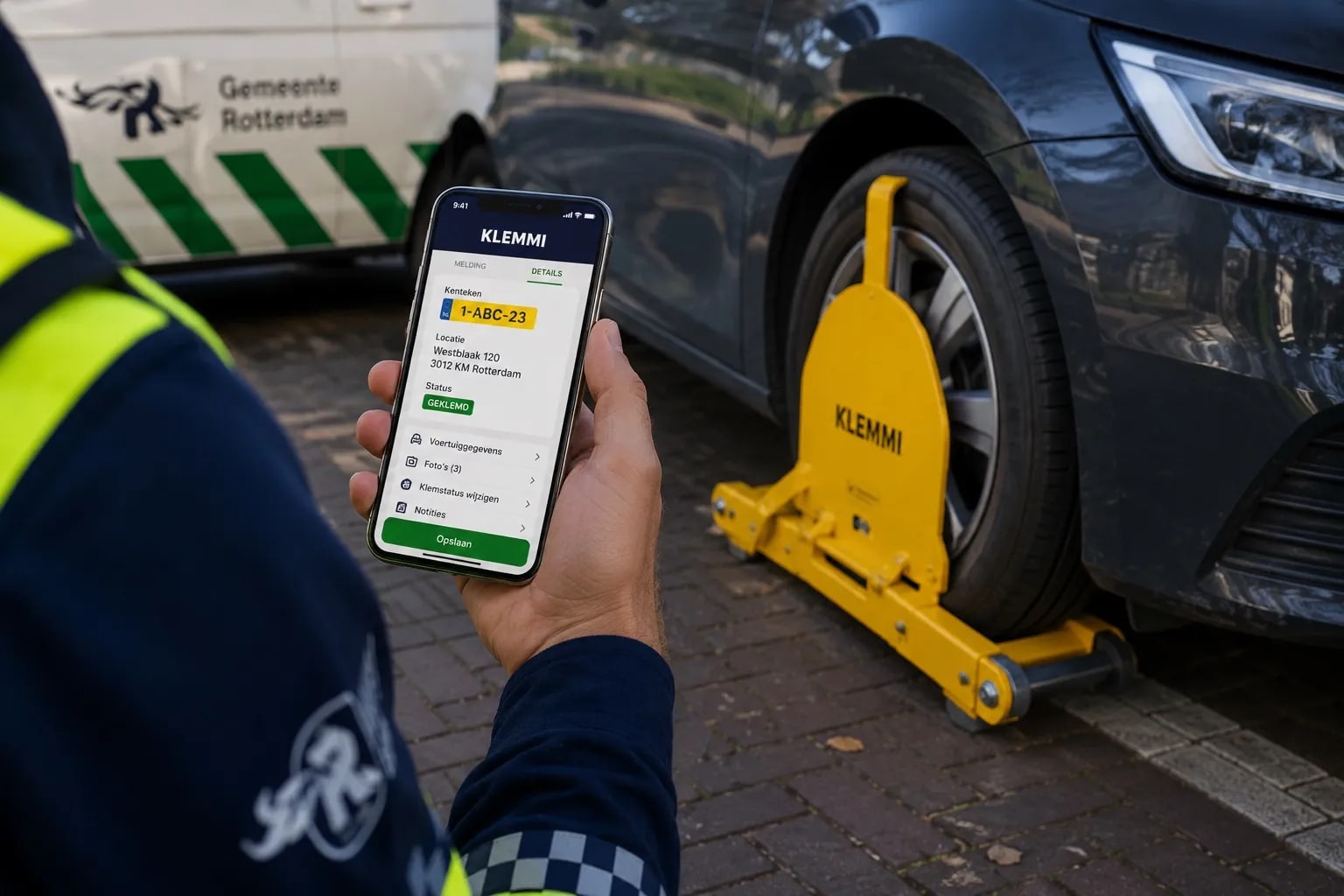
A mobile app that works where your organisation works.
Do employees work on the road or on site? Do you want customers to access a service on mobile? Or do you want processes to run directly on a phone or tablet? JAM-IT builds bespoke mobile applications that fit your users, processes and existing systems.
From offline use and location features to camera, notifications and links with business software: we build the app around what is needed in practice.
Discuss your app idea
You do not have to choose a technical route up front. You bring the business question and the usage situation. We decide which approach fits the functionality, users, integrations and future development of the app.
Discuss your app ideaFor Gemeente Rotterdam, JAM-IT built Klemmi, a mobile app that supports the wheel clamp process on the street. Enforcement officers can look up vehicle details on site, update statuses, capture photos and carry out next steps.
The app supports working without an internet connection and syncs once connectivity returns.
Enforcement officers have vehicle details, location and current status available where the work happens.
Clamping, unclamping and towing run digitally, reducing separate lists and manual handovers.
The app can be used without an internet connection and syncs with the server later.
Employees can consult information, register work and act directly where the work takes place.
Camera, GPS, QR or barcode scanning, notifications and other mobile device options can become part of the process.
Where needed, functionality can be available offline and sync later when a connection is available again.
The user experience is designed for mobile use and the actions people actually perform on the road or on site.
Not every process needs a mobile app. The best form depends on where users work, which actions they perform and how much screen space the task needs.
Often logical when users work on the road or on site, camera, GPS or scanning is needed, notifications matter, offline use is relevant or mobile use is central.
Often more logical for extensive administration, dashboards, complex screens and work that mainly happens at a fixed workplace.
Sometimes a combination is best: a web application for management and administration, and a mobile app for employees who carry out the process on site.
For mobile applications, we choose a development approach that keeps freedom over functionality, user experience, integrations and further development.
The technology and architecture are matched to what the application needs to do and how it is used.
AI can support repetitive parts of development, analysis and testing.
Functionality can be made concrete, tested and adjusted more efficiently.
AI supports the development process. Our developers remain responsible for architecture, technical choices, control and quality.
For registration, inspection, control, execution or access to current information outside the office.
For mobile access to services, information, personal data or processes.
A mobile application that exchanges data with existing business software, APIs, databases or web applications.
For processes where paper, email, separate files or manual entry can be replaced by one mobile workflow.
A mobile application is often part of a wider IT landscape. That is why we can connect the app to existing systems and data sources, so users on the road work with the same information as colleagues in the office.
CRM, ERP, business software, databases, APIs, web applications and external services can be part of the landscape.
Through a suitable integration layer, the mobile app exchanges data with the systems that are leading.
The app shows and registers information in a way that fits mobile use.
Employees or customers can act on site or on the road with current information.
We use only existing JAM-IT cases as proof. Klemmi is the clearest mobile app case; THIS010 also shows how mobile processes for supervision and enforcement can fit a broader application context.
A mobile app for Gemeente Rotterdam that lets enforcement officers look up vehicle data on site, update statuses, capture photos and carry out the wheel clamp process digitally. Read case
An application context for Supervision & Enforcement in which reports, personal data and work by enforcement officers are supported digitally with care. Read case
We map users, processes, goals, existing systems and technical preconditions.
We translate the main user scenarios into a design and, where relevant, a prototype or first working version.
We build iteratively, demonstrate along the way, test and process feedback.
We support delivery and can stay involved with maintenance, support and further development.
Costs depend on functionality, users, integrations, design, technical complexity and possible offline or device functionality. That is why we first map what the app needs to solve and which features are needed. Also read how we look at app development costs.
That mainly depends on the usage situation. If users often work on the road or on site and camera, GPS, scanning, notifications or offline use matter, a mobile app can be logical. For extensive administration, dashboards or work from a fixed workplace, a web application may fit better.
Yes. We develop mobile applications for iOS and Android. The technical approach depends on the functionality, users, integrations and further development of the application.
Our developers use AI to support parts of the development process, such as code generation, analysis, testing and debugging. AI does not take over the development process. Our developers define the architecture, check the results and remain responsible for technical choices and quality.
Yes, in many cases a mobile application can be connected to existing business software, databases or other systems via APIs or other integration options. During analysis we look at which systems are involved and which technical options are available.
Yes. If an existing application is important to your organisation, we can look at maintenance, support and further development. We first assess the technical state, transferability and desired next steps.
Do you know a process could be smarter, but not yet which digital solution is needed? During the free Quickscan we map one existing process together and look at where time, overview or efficiency is lost. The solution does not have to be fixed in advance.
Request the free QuickscanDo you already have a concrete idea, or do you first want to discuss the best technical and functional approach? Tell us what you want to improve. We think along about users, functionality, integrations and a fitting development approach.
Discuss your app idea with JAM-IT.

 Want to know more?Ask Armando