
Stay up to date with the latest developments
Leave your email address and receive the latest developments in software, AI and Mendix.
Leave your email address and receive the latest developments in software, AI and Mendix.

For years, low-code was a logical choice for many organisations. Platforms such as Mendix made it possible to develop software faster, without being completely dependent on traditional development projects. We have built a lot with it at JAM-IT too. But the market is changing.
AI is accelerating software development rapidly. Traditional development is becoming more accessible. And at the same time, organisations are finding that dependence on platforms, licences and fixed structures is increasingly becoming part of strategic choices.
Not because low-code is "bad". On the contrary. In many situations it still works excellently. But because more and more organisations are starting to ask themselves the same question: what happens if our software becomes completely dependent on one platform?
For years, the strength of low-code lay in speed and structure. You could build applications relatively quickly within clear frameworks. Certainly for organisations without large development teams, that was an enormous step forward. But that structure also brings dependencies with it.
Licences. Hosting choices. Platform updates. The way software is technically put together. The moment an application becomes important for daily processes, those stop being technical details and become strategic choices. We notice that more and more often in conversations with organisations. Not because their software has stopped working, but because they are trying to look ahead.
"What happens to costs when applications grow? How flexible are you still in extending them? Can you switch easily? How dependent do you want to be on one supplier? And what happens when the terms change?" Those questions are playing an ever larger role.
At the same time we see that AI is fundamentally changing the way we develop.
Where speed used to be tied mainly to low-code, we now see that AI makes that same acceleration possible within traditional software development as well. Functionality that used to take weeks can now be built up far faster.
That does not mean everything suddenly has to be done "without a platform". But it does mean organisations are rethinking the trade-off between:
For new projects in particular, that trade-off is becoming ever more relevant.
Because if you were starting again today, would you make the same choices as you did five years ago?
The rise of AI does not automatically mean that traditional development becomes easier than low-code. What it does mean is that custom development becomes more accessible.
And with that, the discussion shifts too. No longer: "Can we build this?" But: "How do we want this to stay manageable in five years' time?"
Low-code solves part of that manageability by offering fixed frameworks. That has advantages. Certainly when organisations have already built up knowledge, processes and developers around a platform internally.
But AI-driven development offers more freedom. Less dependence on fixed structures. More control over how software is built and hosted. And that is exactly why the choice is less obvious than it used to be.
The question is more and more often: which dependencies suit our organisation, and which do not?
Building software is one thing. Keeping a grip on it is something else. What we see in practice is that organisations do not necessarily get stuck on technology, but on control.
At a certain point software becomes business-critical. Then it is no longer only about functionality, but also about:
Who can maintain it? Where does it run? What happens when you want to extend it? Can you still move without major consequences?
Precisely now that AI is accelerating development, those become more important questions. Because the faster software can be built, the more important it becomes to think carefully about the foundation.
Within JAM-IT we notice that software development revolves less and less around one technology or one platform. Sometimes Mendix is still the best choice. Certainly when organisations are already fully set up for it or want to keep actively developing within the platform themselves.
But more and more often we combine different forms of development. Traditional software development, AI-assisted development and low-code side by side, depending on what the problem needs. In doing so we look not only at what works quickly today, but also at:
Because in the end software is not only about building. It is about making choices you can still work with as an organisation years from now.
 Want to know more?Ask Armando
AI-assisted development speeds up traditional application development, but the bigger shift is the room it creates to te...
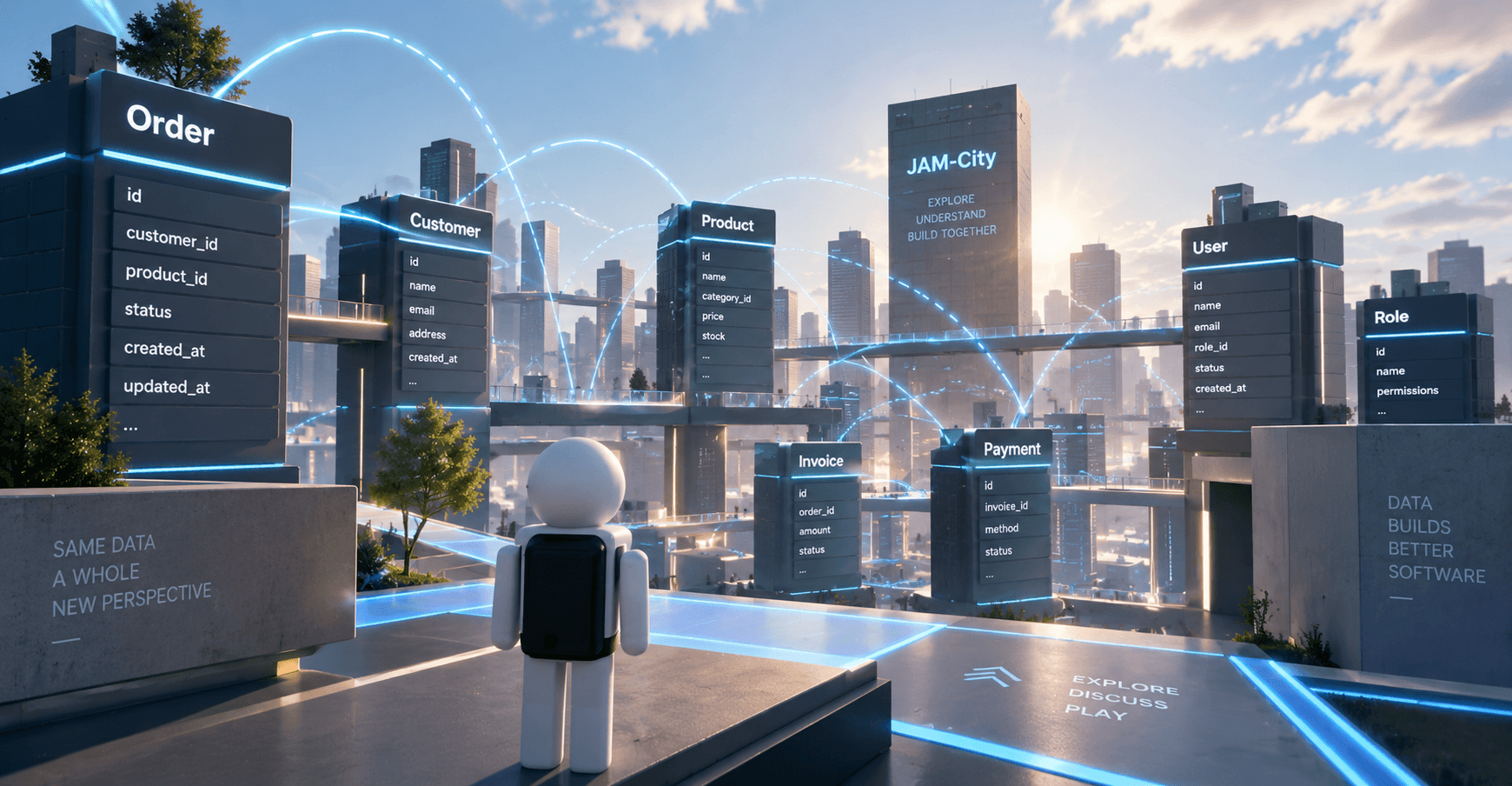
It started as a way to view a database in 3D. It now has a name, JAM-City, and we can walk through it with colleagues, d...

What will users expect from software in the future? Discover what makes an application future-proof and which choices ma...