
Stay up to date with the latest developments
Leave your email address and receive the latest developments in software, AI and Mendix.
Leave your email address and receive the latest developments in software, AI and Mendix.
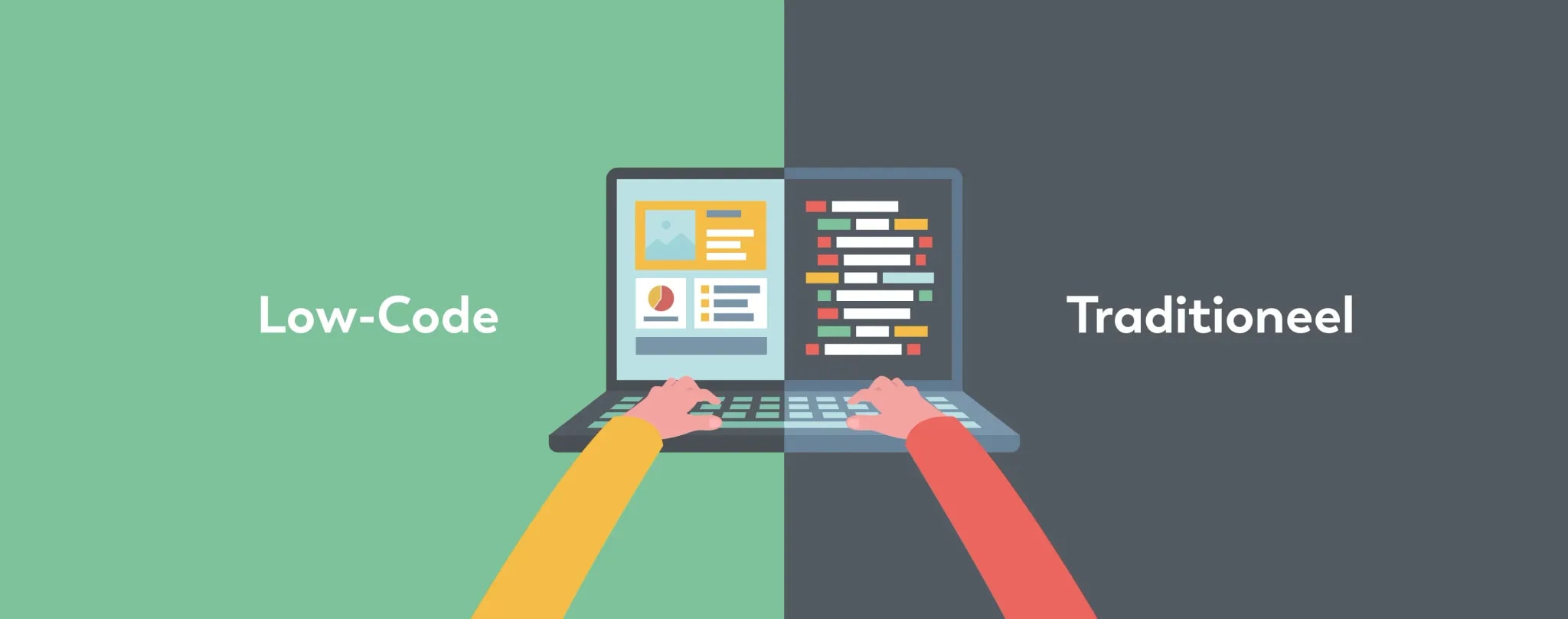
Which technology do you choose for your application: low-code or traditional? At JAM-IT we work with both techniques and we are glad to advise you on the best choice.
Are you thinking about developing (or having someone develop) a web or mobile application? Then you can do that in two ways: through a low-code platform or through traditional programming.
It does not matter whether you want to build a native app or a web application. But how do you decide which technology suits your application? In this blog we set out the pros and cons.
Would you first like to know what an application development process at JAM-IT looks like?
When developing applications, people often think of traditional programming. That means building an application with a programming language (such as Java or JavaScript). Another way is with a low-code platform such as Mendix, where you use ready-made building blocks that you drop into the application easily.
Both methods have their pros and cons, and the choice for your application really depends on what you consider important. Think of the speed at which you can build, future plans for several applications, the costs, and so on. Below we explain the pros and cons of low-code and traditional programming.
With traditional programming it takes longer to build a first version of an application, because you have to arrange peripheral matters such as privacy, security and the database yourself. Low-code platforms work faster because all of this is already taken care of. That means you can put an application live within a week. A good example of this is the Corona app from the Gemeente Rotterdam.
Together with Gemeente Rotterdam, JAM-IT developed an application for GGD Rotterdam-Rijnmond within two days to register potential Corona patients. Read here how they managed it
The costs look slightly different for each method. With a low-code platform you pay monthly licence costs for as long as the app is online. After all, you can use the platform's services all that time. That pays off if you actually use those services; for example if it concerns an important app that is developed further continuously so the app can respond to changes in the world (moving with the times), or if several apps are being built.
With traditional programming you in principle only pay the costs of building the app and then the hosting costs. That is advantageous if less further development is needed, for example applications that are known to be temporary.
Working with an external platform means on the one hand that you enjoy the benefits of that platform, but on the other hand that you are dependent on an external party. They may adjust their prices, services and terms in the future. That is important to weigh up.
Low-code programming is ideally suited to digital transformation: you can develop software yourself and thereby keep innovating and responding to a fast-changing market, without becoming an IT company. This is explained further in the blog 'developing applications yourself with low-code'.
With a low-code platform you can put your own employees to work helping to develop and manage the app, which is also known as Citizen development. Your company's whole mindset becomes Agile, in other words adaptable. That makes it easier to respond to what is happening now and adjust the app, so you can meet customers' requirements and expectations (even) better.
Traditional development requires knowledge of programming languages and technical peripheral matters. If you do not have this knowledge within your own company, you will have to outsource it to an IT company.
| Low-code | Traditional | |
| Speed | ++++ | ++ |
| Digital transformation | ++++ | ++ |
| Recurring costs | Licence | Hosting |
| Independence | ++ | ++++ |
| Styling (appearance) | ++++ | ++++ |
With this blog we want to inform you about low-code and traditional programming, so you know which solution best fits your situation. You should now have a clear picture of these technologies and their pros and cons.
It is important to know that both technologies can handle the same complexity and functional solutions. You do not have to be a large company to do one or the other; both technologies are suitable for large and small companies alike.
When we develop an application for your company, we first sit down with you to discuss the factors above. In doing so we try to build as clear a picture as possible of which solution you are looking for now and what your future plans are. On that basis we issue advice on the right technology for your application, so you make a good choice for the short and the long term. And after that we will of course build the app for you, in low-code or in the traditional way.
 Want to know more?Ask Armando
In today's world, every company needs more and more software. Think of applications that improve processes, and applicat...

For a long time low-code played a supporting role in software development. The larger, more complex applications were bu...
With the low-code platform Mendix you can easily build apps that work well, even if you do not have much programming exp...