
Stay up to date with the latest developments
Leave your email address and receive the latest developments in software, AI and Mendix.
Leave your email address and receive the latest developments in software, AI and Mendix.

In a team with several developers, working together is crucial. But everyone has their own way of working, and their own way of building something. That often makes it hard to work in the same model together.
This problem grows as the organisation grows. With dozens of developers and dozens of projects, it becomes ever harder to keep track of it all and to develop efficiently. So how do you make sure you can work together as well as possible?
To work together well, it is important to make agreements with each other about how you work. These can be very broad agreements, such as a standard approach to a project, but also very detailed ones, such as the approach to a specific task, the workflow of a task, the naming of elements and so on. Agreements of this kind are called conventions, and they make sure everyone works in the same way.
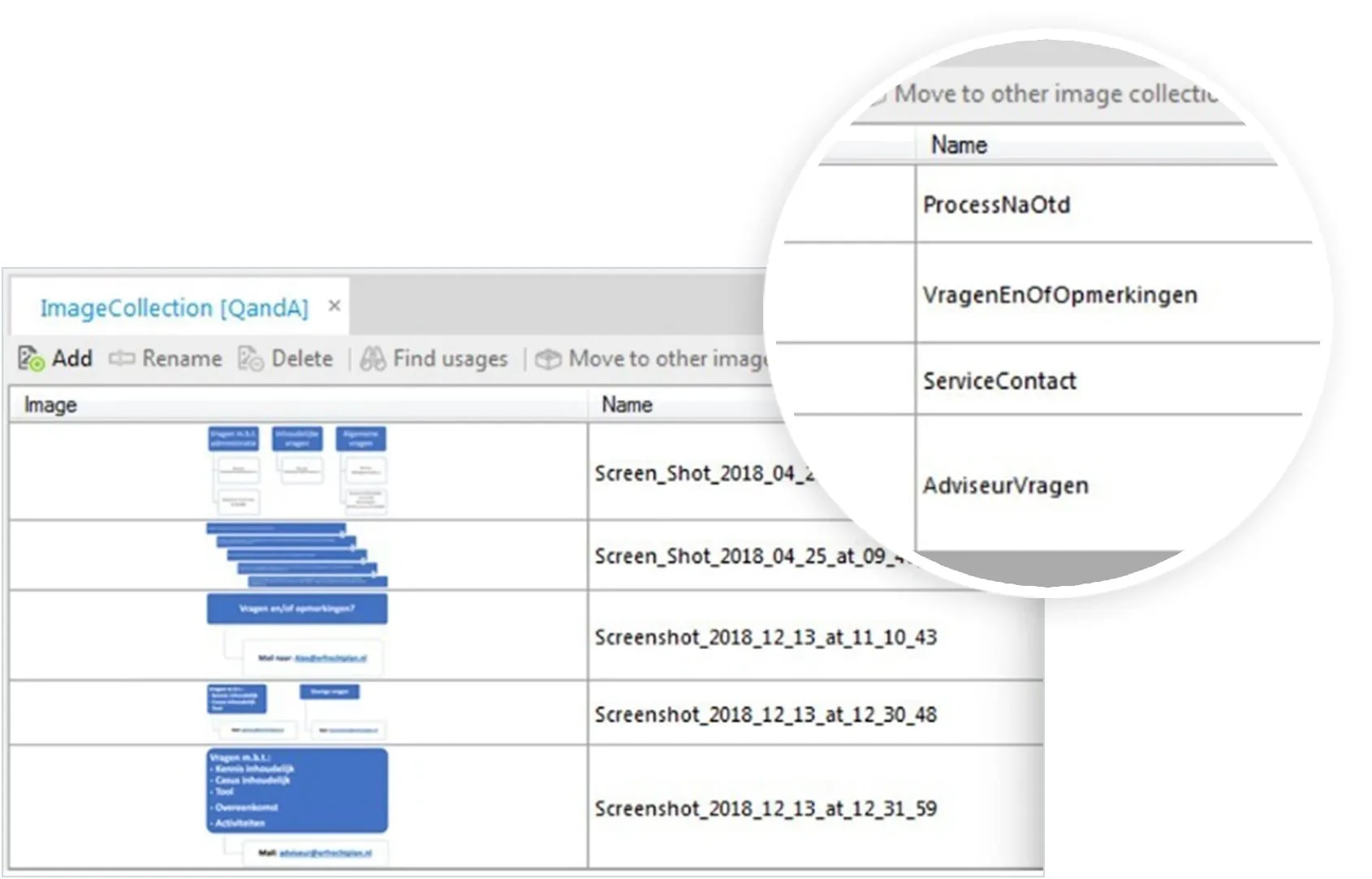
One example of such a convention is the naming of elements. When writing source code it is often not possible to use spaces. There are various solutions for that, such as using a capital letter at the start of each new word. If everyone does it differently, the project becomes messy. That is why we have chosen one method (PascalCase) that everyone uses. Thanks to this convention our developers can work more tidily and the source code is a good deal clearer. This is a simple example, but there are also deeper conventions that are essential for development, such as preventing 'spaghetti code'.
If everyone follows the same conventions, developers can easily take over each other's work. It also becomes easier to manage the project, because it is consistently set up in the same way, and the chance of errors gets smaller. In short: conventions save trouble, time and money.
Using conventions sounds perfectly logical in theory. But developers are often busy and working on several projects at once. It can then be hard to keep checking whether you are following the conventions, let alone to learn new ones.
The solution is to automate the conventions. That can be done by having the source code checked automatically against the conventions. There are various tools for this that analyse the source code regularly (every night, for example) and report where errors need to be fixed. But a number of problems come with that.
First of all, the developer does not notice during development that something is going wrong, and so cannot act on it straight away. Second, developers often have other urgent tasks to do, so the report is left untouched. Because there is no consequence if the problems are not fixed, nothing is done with it. The errors then pile up, which makes it more and more work to trace and correct them.
That is why we developed a code quality analyser for Mendix, a tool that analyses the source code in real time so the developer can take action immediately when something goes wrong.
The analyser checks everything the developer does, blocks when something goes wrong and indicates what needs to be improved. The developer then makes a small change to fix it and can carry on with their work.
That way everyone follows the conventions automatically, which makes the work a good deal more efficient. Because development is done the right way from the very start, the project stays 'clean' and consistent. So there are no problems to fix afterwards, and everyone can easily get to work on each other's project.
The code quality analyser is part of JamOps, a tool from JAM-IT that raises the quality of applications and makes development easier, more efficient and more secure. Read more about JamOps here.
 Want to know more?Ask Armando
We have added a feature to our JamOps tool to prevent data in a Mendix application being lost.

Privacy, GDPR, contracts, leave, time tracking, invoicing: as an organisation grows, so does everything you need to arra...

Anyone who knows JAM-IT knows that we believe strongly in structure, quality and ownership. Not as buzzwords, but as a f...